


Unlimited, inexhaustible, clean energy – free for everyone. Fantasy or real? According to Christopher Dunn, ‘free energy’ is not only possible but was a reality for the Ancient Egyptians.

A lifelong master craftsman, machinist, and engineer with experience in aerospace and a focus on precision and laser application, Dunn became fascinated with the Great Pyramid at Giza after reading Peter Tompkins’ iconic book The Secrets of the Great Pyramid. He spent more than 20 years studying the Great Pyramid and other Egyptian sites.
Due to his engineering background, Dunn saw things in the Pyramid’s construction that others missed. Most people marvelled at the Pyramid’s size and asked, “How did they do it?” Dunn examined its precision and asked, “Why was it necessary?”
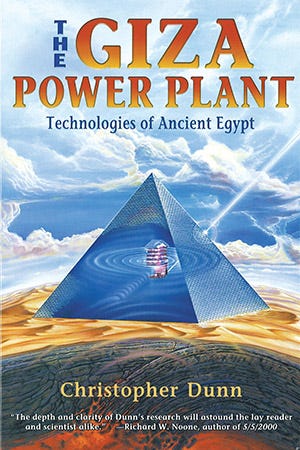
Dunn burst into the limelight with the 1998 publication of The Giza Power Plant: Technologies of Ancient Egypt. Dunn revealed that the Great Pyramid was a giant power generator – an acoustical device that created harmonic resonance with the Earth and converted the planet’s natural vibrations into usable energy for an ancient civilisation. He showed that the Pyramid’s numerous chambers and passageways were positioned with deliberate precision to maximise acoustical qualities.
In 2010, he followed up with Lost Technologies of Ancient Egypt: Advanced Engineering in the Temples of the Pharaohs, a unique study of the engineering and tools used to create Egyptian monuments, proving beyond a shadow of a doubt that advanced knowledge and machining was utilised.
Dunn’s new 2024 book, Giza: The Tesla Connection: Acoustical Science and the Harvesting of Clean Energy, expands his hypothesis that the Great Pyramid at Giza was built as an advanced energy-harvesting machine.
Dunn proposes that the Ancient Egyptians used the Great Pyramid to generate clean free energy, similar to what genius inventor Nikola Tesla later envisioned, as indicated in the title of his new book.
Today, the world is suffering an energy crisis. The solution to our woes might be literally staring us in the face – on the Giza plateau. Will anyone listen?
In an interview with New Dawn magazine, Christopher Dunn said many things. Here is part of his interview.
NEW DAWN: What discoveries have been made since the publication of The Giza Power Plant?
Christopher Dunn said: For those not familiar with the book, The Giza Power Plant: Technologies of Ancient Egypt is a reverse engineering exercise that began in 1977. The objective was to find a reason why every feature discovered in and around the pyramid exists. In a nutshell, it describes the Great Pyramid as a machine, the function of which was to draw energy from the Earth and distribute it to the inhabitants at that time. This ultimately led to the publication of the book in 1998.
While there has been a lot of discussion about lost civilisations and ancient cataclysms, my intention while writing the book was to focus primarily on the physical evidence inside and around the Great Pyramid. Having said that, it is becoming clearer now, with the fine work of other investigators and their introduction of new evidence, that a cataclysm occurred in antiquity and the Great Pyramid, along with everything else existing in physical form that sustained a sophisticated society, was damaged beyond repair, as was the civilisation that built it.
Since The Giza Power Plant was published, quite a few discoveries have been made in and around the Great Pyramid that support and allow refinements and strength to the theory. In chronological order, they are:
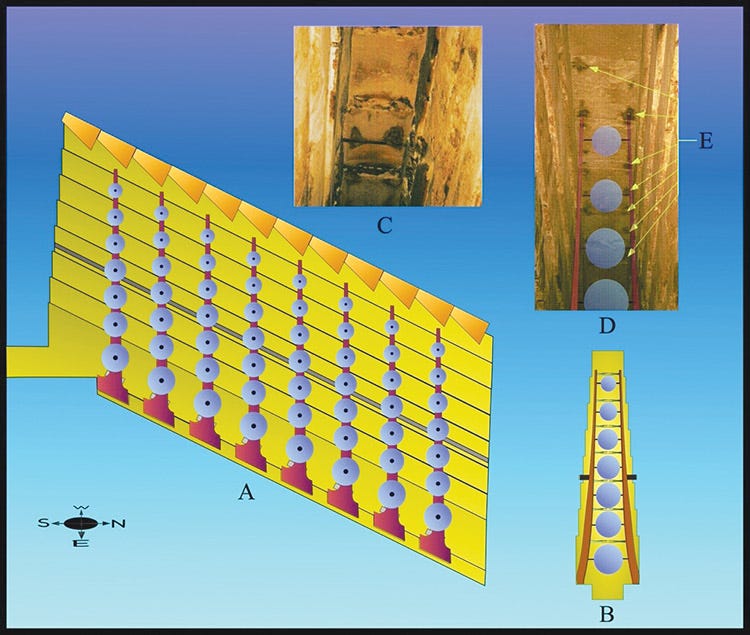
• In 2001, while being filmed for a documentary on the Giza Plateau near Cairo, Egypt, I received permission from Zahi Hawass [Egypt’s Minister of State for Antiquities Affairs at that time] to go inside the Great Pyramid, which had been closed for cleaning. While inside the Grand Gallery, I noticed and photographed scorch marks on the ceiling. The pattern matched my theorised design of the frames that held a series of acoustic resonators. In The Giza Power Plant, I posited there was a hydrogen explosion inside the King’s Chamber that pushed out the walls and cracked the ceiling beams. I did not believe that evidence to support this theory would exist in the Grand Gallery, but in consideration of all other evidence, it would have been perfectly reasonable to do so. I just didn’t think of it at the time.
• In 2002, the Queen’s Chamber South Shaft was explored by a robot named Pyramid Rover, designed and built by iRobot in Massachusetts, USA. The hydrogen that exploded, I theorised, was created in the Queen’s Chamber. This conclusion was reached by examining evidence that had been discovered related to the chamber and its North and South Shafts.
With much fanfare and an audience that had been primed to be glued to their televisions for the intended broadcast of new pyramid discoveries, the Pyramid Rover prepared to climb the shaft and drill through a limestone block at the end. This blockage was first discovered by robotics engineer Rudolph Gantenbrink in 1993 and subsequently labelled “Gantenbrink’s Door.” While preparing to drill through the blockage, the thickness of the door was measured using an impact-echo probe and determined to be 3.25 inches thick. My illustration of this “door” showed a thickness of 3.6 inches.
The image captured by an endoscopic camera inserted through the hole showed another blockage approximately 10 inches from the “door.” Not much else that was remarkable was revealed in the South Shaft at this time. No other theory offered at the time regarding what would be revealed was correct. However, what was revealed did not negate my theory, but for it to be proven 100% correct, more information was needed.
Little did I know at the time that further validation of the theory was discovered after the iRobot team completed their work in the South Shaft and the documentary production crew departed. Before packing up their equipment and exiting the pyramid, the iRobot crew sent the Pyramid Rover robot up the North Shaft. Gantenbrink had attempted to explore the North Shaft in 1993, but could not navigate beyond two long exploratory rods that had somehow become stuck where the shaft turns on an angle to the left. Using a different tactic, by turning their robot 90 degrees so that it gripped the walls instead of the floor and ceiling, the Pyramid Rover was able to ride over these obstructions.
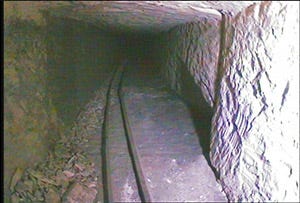
Pyramid Rover revealed two pieces of evidence supporting my theory about using these shafts. One was an opening in the East wall near one of the bends approximately 90 feet up the shaft from the Queen’s Chamber. I theorise that chemicals were introduced into the shaft behind the blockage, but this evidence showed that the entrance for the chemicals was lower down.
The other evidence revealed was the existence of another blockage, similar to the South Shaft, but with electrodes that were not corroded and with one that was recessed and showed signs of electroplating.
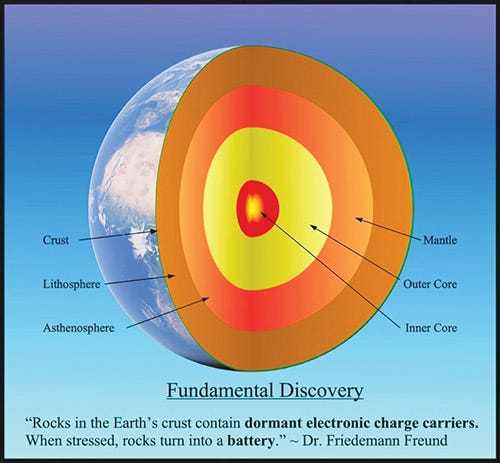
• In 2006, Dr. Friedemann Freund, a NASA physicist, completed his laboratory experiment confirming his theory that earthquake lights were the result of electron flow propagating through the lithosphere when peroxy defects in their minerals were subjected to stress. His conclusion was that under certain conditions, igneous rock beneath our feet turns into a giant battery.
• In 2010, another robot team from Leeds University in the UK, and headed by Chinese dentist Dr. TC Ng, fashioned a different style of robot which Dr Zahi Hawass named Djedi, the name of Khufu’s magician [in reference to Pharaoh Khufu of the 4th Dynasty who is said to have commissioned the Great Pyramid]. The Djedi robot was equipped with a snake camera that was able to look around the small space and even look behind Gantenbrink’s “door.” The images it captured allowed me to slightly modify my engineering design, but overall supported my proposed function for these features.