


Note: If you find my article in your spam folder, please mark it as 'not as spam'. Recently, some of my subscribers told me that my articles are no longer showing up in their inbox and are going straight to the spam folder instead. That's when I realized that Google Gmail has suppressed my publication; perhaps they don't like my writing. This is happening to many other Substack writers as well; the same thing is happening with some of my friends who are also Substack writers. So please, if it goes to your spam folder, mark it as 'not as spam'.
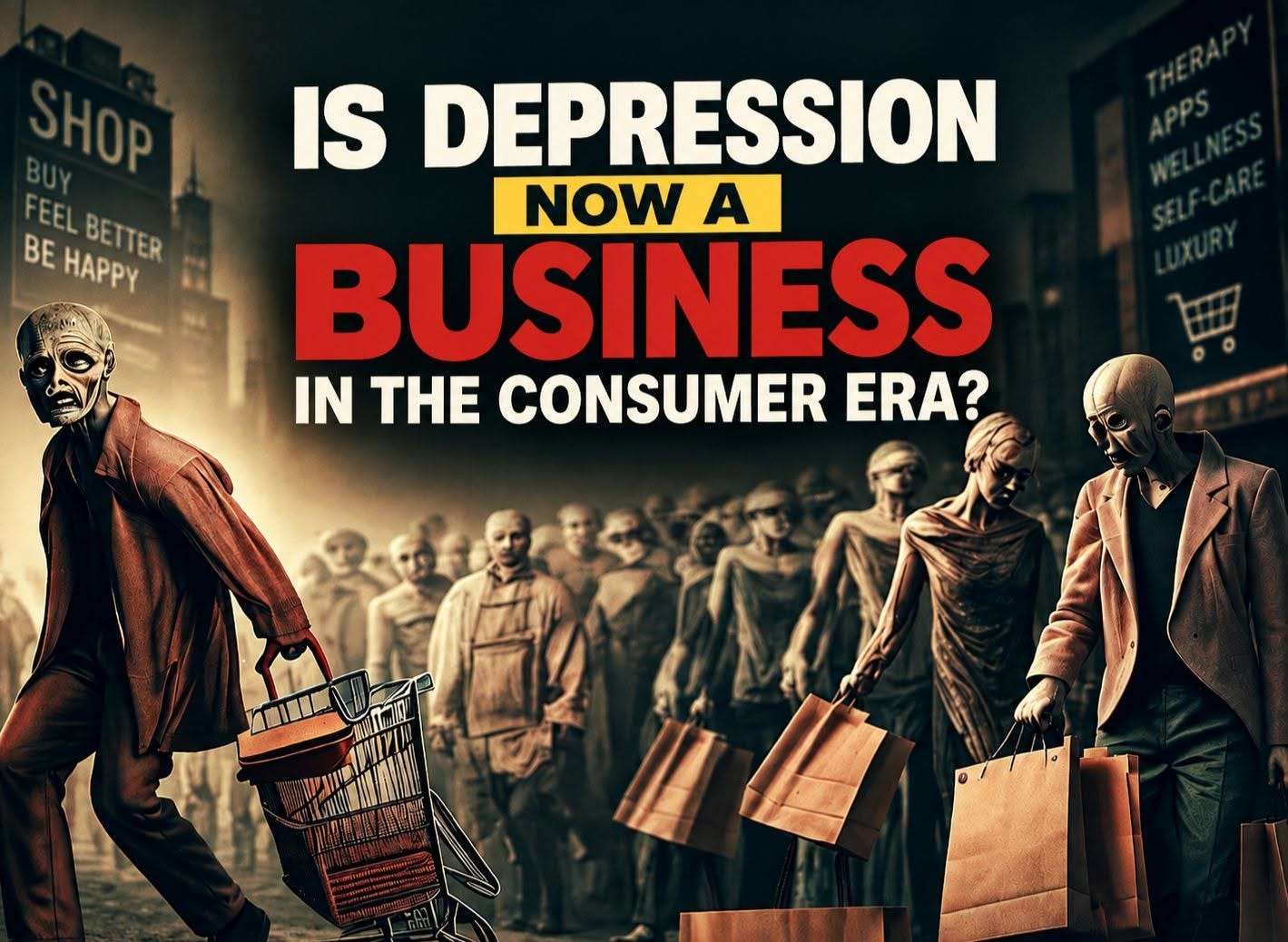
Has depression now become a business of sorrow in this era of consumerism?
Perhaps my words might seem like mere emotional anger or an imaginary doubt, but looking toward the deep structural analysis of the late-capitalist market system makes the naked reality behind this clear.
We are passing through such a strange socio-economic reality where even people’s most primitive, secluded, and painful feelings have been transformed into flawless products. Consumerism first makes people lonely and exhausted through the rat race, uncertainty, and alienation, and subsequently builds a multi-billion-dollar international business industry precisely in the name of filling that void.
This matter is not merely concept-driven; clear proof of this is found in various psychological researches alongside the hard statistics of the market. According to researchers of communication and business studies, in modern consumer society, shopping is no longer just a medium for meeting physical needs—it has become a psychological tool to keep the mind well, gain social recognition, and seek mental joy or entertainment. Research shows that when people suffer from mild to moderate depression or melancholy, a strong tendency for hedonic consumption—purchasing pleasurable and consumerist products to make themselves feel a bit better—develops within them.
Capitalism has set various artificial traps capitalizing on this natural mental void of humans, which forces us subconsciously to spend money from our pockets. “My mood is not good, let’s go do a little shopping” or “My mood is not good, let’s go to some glossy restaurant outside and eat fancy food”—in today’s market, these artificial habits have been injected as antidotes to mental peace. But these are no real solutions, rather merely temporary dopamine hits. The more people pile products into shopping carts to cover up depression or go to expensive restaurants to enjoy the artificial vibe of cafe culture, the more capitalism’s cash register rings. However, the ultimate truth is that when the level of depression reaches a severe to deeper stage, the very desire to seek joy through this artificial shopping or consumption completely vanishes from people.
Similarly, a massive market for this is visible in the global economy as well. According to international statistics, the global mental health market has already crossed 100 billion dollars, making it one of the fastest-growing growth sectors for investors. On the other hand, the global market for antidepressant medications to reduce depression has grown year by year to reach over 23.5 billion dollars, and tech businesses like virtual therapy and meditation apps have surpassed 9 billion dollars. Research shows that compared to a satisfied person, a depressed and lonely person spends the most time on screens and makes more impulse purchases. As a result, an individual’s psychological loneliness is the core fuel of the algorithmic dopamine economy.
It is crucial to understand how depression transformed from a structural issue into a commercial product from a deep socio-philosophical perspective. Cultural theorist Mark Fisher described this in his famous book Capitalist Realism as the “Capitalist Realism” of mental health. Society’s hyper-competitive environment, economic uncertainty, and mechanical lifestyle constantly isolate and sadden people. But the market system masks this structural or political failure and shifts all blame onto the individual. People are made to believe that the problem does not lie in society’s toxic system, but is purely a chemical imbalance in their brain or a personal failure. Consequently, instead of raising demands for social change or collective resistance, people buy medicine, therapy packages, or paid courses as personal solutions.
Similarly, where the primary condition for mental well-being was pausing for a moment, returning to nature, or coming close to people, modern consumerism has branded the concept of self-care and turned it into a luxury product. An artificial social sense has been created that self-care or mental nourishment is incomplete unless one buys expensive scented candles, skincare items, or exclusive wellness packages.
The alienation of labor that Karl Marx spoke of during the era of the Industrial Revolution has today spread to every level of human existence. As a result of hyper-individualism, natural spaces like family, friends, or social gatherings have shrunk. The spaces of selfless human relationships, where once the burden of the mind could be unburdened free of cost or empathy could be found, have now been taken over by fee-based monetized services.
To escape this human isolation and depression, a strange new artificial trend of relationships with Artificial Intelligence (AI) has been created in today’s era. Instead of facing the flaws, complexities, or emotions of a real ordinary person, people are now searching for a “perfect companion” inside AI. Relationships are forming between wives and AI bots, and relationships between husbands and AI as well, where there is no argument, no demands, only fake empathy and flawless attention. But in trying to find that imaginary perfectionism or flawless behavior among real people, intense friction and distance are ultimately being created in marital and family relationships. The market is pushing us away from humans and making us slaves to artificial algorithms, and to cover up that sorrow, it is forcing us to buy yet another new artificial service or artificial relationship.
Of course, there is no opportunity to deny the importance of medical science or professional psychiatric therapy; in cases of severe clinical depression, science-based proper treatment saves lives. But the crisis arises when the normal grief, exhaustion, existential crisis, and social suffering of life are blanketly turned into a disease or depression, and brand stickers or barcodes are slapped onto them.
Depression is not a fashion, and the true meaning of life cannot be found in shopping cart purchases, restaurant fancy foods, or the fake love of algorithms. Intellectually recognizing this business of sorrow of capitalism is the first step toward awareness. True mental relief does not lie in shiny brand packaging, AI chatbots, or app subscriptions; it lies in genuine human bonding, awareness against social mechanization, and the inherent strength not to let one’s deep emotions and feelings be turned into market commodities.
Revealed Eye is my full-time, independent work. This platform allows me to stay free from corporate influence, sponsors, and filters and to focus entirely on researching and writing.
If you’d like to support this work and help keep Revealed Eye, consider becoming a paid subscriber. Your support makes it possible for me to keep digging deeper, sharing in-depth investigations, and publishing exclusive content.
I’m running a special for $40/year or $5/month.
To see how readers have benefited from this publication and the community it has built, you can view their feedback here.
More will never be enough
Is called plastic therapy. Aware of this since the 80's