



For decades, colonoscopies have been marketed as the gold standard for colorectal cancer screening. Millions undergo the procedure each year, convinced it’s the safest and most effective option. But what if the risks are higher than advertised—and what if safer, non-invasive alternatives are being ignored in favor of profit?
In this article, we’ll dive into the history of the colonoscopy, examine the risks and complications, expose how the medical industry profits from overuse, and offer non-invasive alternatives that may be a better choice for many people.
The History of Colonoscopy: A Modern Invention with Outdated Assumptions
The colonoscopy was introduced in the late 1960s, with the first flexible fiber-optic models emerging in the early 1970s. It was a technological leap in gastrointestinal diagnostics, offering real-time imaging of the colon. By the 1990s, colonoscopy became widely adopted for colorectal cancer screening in adults over 50.
However, its acceptance wasn’t based on long-term outcomes, but rather on the ability to visualize and remove polyps. Over time, colonoscopy became less about necessity and more about routine—despite mixed evidence about its impact on mortality reduction. A 2022 European study (NordICC trial) shocked the medical community by suggesting colonoscopies may reduce the risk of death far less than previously believed—only around 18% rather than the often-quoted 68–70%.
The Hidden Risks of Colonoscopy
Despite being labeled as routine, colonoscopy carries real risks—some of which are rarely discussed:
Perforation of the colon (1 in 1,000 procedures)
Internal bleeding, especially after polyp removal
Adverse reactions to sedation
Infection risk from improperly sterilized equipment
Post-colonoscopy syndrome: bloating, cramping, fatigue
False positives that lead to unnecessary surgery or stress
In older adults or people with chronic illness, these risks increase. Furthermore, the prep process—aggressive laxatives and fasting—can cause dehydration, electrolyte imbalances, and gut microbiome disruption.
Colonoscopies and Big Medicine: A Billion-Dollar Industry
The colonoscopy isn’t just a medical procedure—it’s a profit engine. In the U.S. alone, the colonoscopy market generates over $12 billion annually. Hospitals and private practices charge $2,000–$5,000 per procedure, with many doctors recommending routine screenings every 10 years, even for low-risk patients.
Many health systems offer bonuses or performance incentives tied to screening quotas. Insurance companies often fully cover colonoscopies, encouraging overuse. This creates a system where financial gain can outweigh patient-centered decision-making.
There’s little incentive to educate patients about non-invasive screening methods, or about whether they even need a colonoscopy based on their health history.
Non-Invasive Alternatives to Colonoscopy
Thankfully, several non-invasive options exist that are safer, more affordable, and less stressful:
1. FIT (Fecal Immunochemical Test)
A simple at-home stool test that detects hidden blood in the stool, a possible sign of cancer or large polyps.
Cost: ~$20–$40
Frequency: Annually
Effectiveness: Good for detecting early-stage cancer
2. Cologuard
A DNA-based stool test that detects altered DNA and blood in the stool, potentially linked to colorectal cancer.
Cost: ~$500
Frequency: Every 3 years
Effectiveness: ~92% sensitivity for detecting cancer
3. CT Colonography (Virtual Colonoscopy)
A CT scan that generates 3D images of the colon. No sedation required.
Cost: ~$500–$1,500
Frequency: Every 5 years
Risks: Radiation exposure, may require follow-up colonoscopy if abnormality is found
Do You Really Need a Colonoscopy?
Most people are told to get a colonoscopy at age 45 or 50, but individual risk varies widely based on genetics, diet, lifestyle, and symptoms. For low-risk individuals with no family history or symptoms, a combination of FIT and lifestyle-based prevention may be sufficient.
Important considerations before undergoing colonoscopy:
Do you have any symptoms (e.g., blood in stool, unexplained weight loss)?
Do you have a family history of colorectal cancer?
Are there less invasive tests that could give adequate information?
Have you discussed alternatives with a non-biased provider?
Prevention Over Detection: The Lifestyle Factor
Colorectal cancer is often preventable with lifestyle intervention, but that doesn’t make money. Reducing processed food, seed oils, alcohol, and sugar, while increasing fiber, micronutrients, and whole foods can make a dramatic impact. Emerging research also links gut microbiome health to colon cancer risk.
Ironically, colonoscopy prep often disrupts gut bacteria, while a clean diet supports long-term colon health without the scope.
The Hidden Dangers of Ozempic: Why the Carnivore Diet Might Be the Better Choice
Discover the truth behind Ozempic, its side effects, Big Pharma’s profits, and why the carnivore diet could be a safer, more effective solution for weight loss.
Ozempic’s Popularity Surge
Ozempic has taken the health and weight loss world by storm. Originally developed to treat type 2 diabetes, it’s now being widely used off-label as a weight loss drug. But beneath the media buzz lies a darker story—one involving dangerous side effects, billion-dollar profits, and a system that profits more from sickness than health.
What Is Ozempic? A Brief History
Approved by the FDA in 2017, Ozempic (semaglutide) is a GLP-1 receptor agonist designed to regulate blood sugar in type 2 diabetes patients. But once it was discovered that users lost weight while on the drug, the pharmaceutical industry saw a golden opportunity.
Enter Wegovy, a higher-dose semaglutide product marketed specifically for weight loss. In just a few years, these drugs transformed Novo Nordisk into one of the most profitable pharmaceutical companies in the world.
The Real Dangers of Ozempic
While some see Ozempic as a miracle fix, its side effects can be severe. These include:
Chronic nausea and vomiting
Muscle loss and fatigue
Gallbladder disease and pancreatitis
Depression and suicidal thoughts
Potential thyroid tumors
Even worse, studies show that weight gain often returns once the drug is stopped. It doesn’t treat the root of the problem—it masks it. Meanwhile, Big Pharma profits off long-term prescriptions and dependency.
Ozempic’s Billion-Dollar Business Model
Ozempic and Wegovy generated over $30 billion in revenue by 2024. These are not curative drugs. They are designed to be taken indefinitely—a model that serves profits, not patients.
The pharmaceutical industry has no incentive to promote food-based healing or sustainable lifestyle changes. Why would it, when it profits so heavily from managing symptoms?
An Alternative That Works: The Carnivore Diet
The carnivore diet offers a radically different path. By eliminating processed foods, sugar, and inflammatory seed oils, and focusing on nutrient-dense animal products, people are reversing insulin resistance, losing weight, and regaining their energy—naturally.
Benefits include:
Stable blood sugar and insulin levels
Increased satiety and reduced cravings
Reduced inflammation and joint pain
Mental clarity and stable moods
Weight loss without muscle wasting
This approach doesn’t require injections, prescriptions, or endless visits to the doctor. It’s real food. Real healing.
Carnivore vs. Ozempic: A Comparison Table
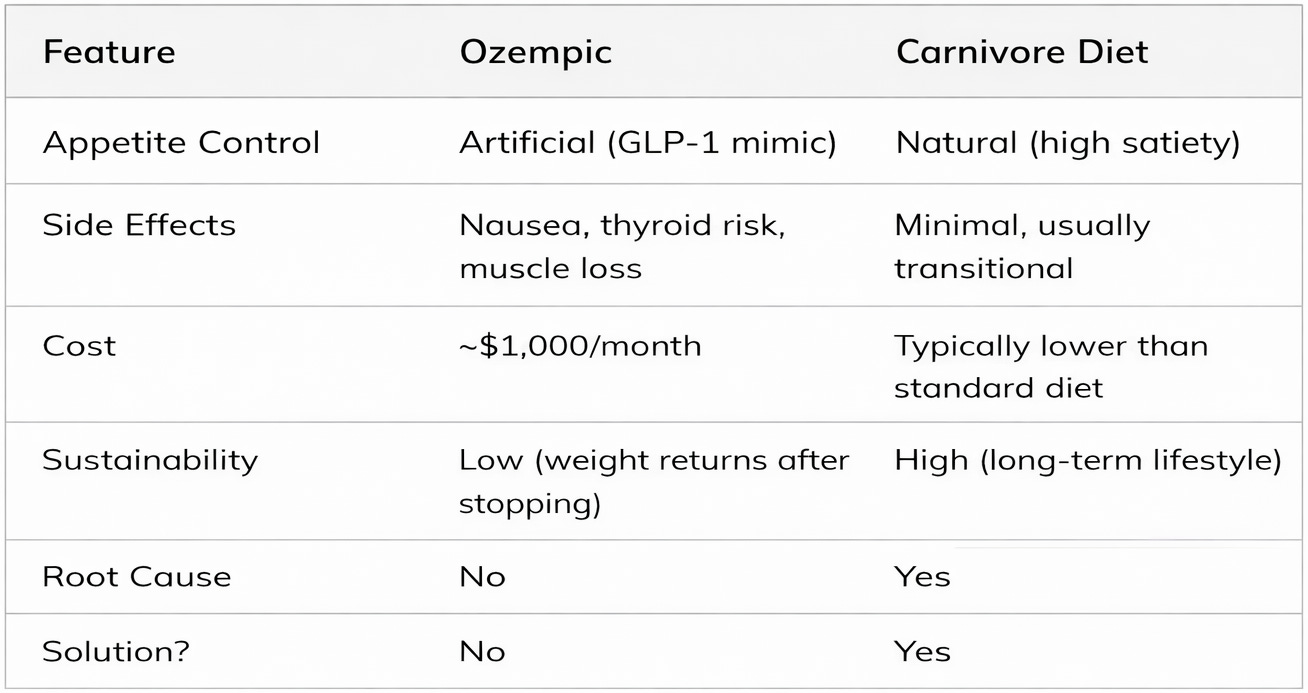
Why Aren’t Doctors Recommending Carnivore?
Most medical professionals receive minimal training in nutrition, and what they do learn often supports outdated guidelines. The influence of pharmaceutical companies in medical education and practice is deep and persistent. It’s no wonder lifestyle interventions like the carnivore diet are rarely offered as an option.
But a growing number of doctors, athletes, and health professionals are turning to meat-based diets—and reporting remarkable transformations.
Take Back Your Health
Ozempic may offer a quick fix, but it’s not a long-term solution—and it comes with serious risks. If you’re tired of putting your health in the hands of billion-dollar drug companies, it may be time to look at food as medicine. The carnivore diet is a powerful, natural, and sustainable alternative for those ready to take control.
Author’s note: If you find value in what I write - if it supports your research, challenges your assumptions, or helps you see things most people never question - I want you to know that it truly matters to me.
Revealed Eye is my full-time, independent work. This platform allows me to stay free from corporate influence, sponsors, and filters and to focus entirely on researching and writing.
If you’d like to support this work and help keep Revealed Eye, consider becoming a paid subscriber. Your support makes it possible for me to keep digging deeper, sharing in-depth investigations, and publishing exclusive content.
To see how readers have benefited from this publication and the community it has built, you can view their feedback here.
I totally agree, my Dad was in his upper 80s, healthy with no problems and was persuaded to have his “routine” colonoscopy, had a reaction to the anesthesia, fell and fractured a shoulder blade, mistakenly had surgery for that on his doctor’s recommendation, went downhill from there and died less than a year later, he probably would’ve lived another 5-10 years if he hadn’t had the colonoscopy!!
Thank you your insightful research in this matter my wife has been recently put on Ozempic, and I know from another woman’s experience she told us she is now on a feeding tube for life, and I am worried for my wife, I know a person who owns a health food store who went on a carnivore diet who lost a whole bunch of weight. So I see a lot of truth in what you say