


In my opinion, the magnificent facility in Colorado Springs—the device Nikola Tesla constructed to conduct experiments with the wireless conveyance of energy—is not the “usual transformer” it is often described as. Instead, it is a machine of extremely great complexity (despite its apparently simple construction), and it is actually a kind of “overunity” machine.
Like many others of similar construction, this device was often compared to Marconi’s and similar radio transceivers, whose operations were based on classical (Hertzian) electromagnetic (EM) waves, which are described in detail by Maxwell’s equations. However, we must consider the fact that the wireless conveyance of energy Tesla sought to achieve was based on waves of a fundamentally different nature. He constantly emphasized this fact, supporting it with numerous and highly precise written arguments. One such confirmation can be found in his US patent No. 5,780 from February 19, 1900, titled “Apparatus for Transmission of Electrical Energy” /5/, where Tesla states:
“... It is to be noted that the phenomenon here involved in the transmission of electrical energy is one of TRUE CONDUCTION AND IS NOT TO BE CONFOUNDED WITH THE PHENOMENA OF ELECTRICAL RADIATION which have heretofore been observed and which from the very nature and mode of propagation would render practically IMPOSSIBLE THE TRANSMISSION OF ANY APPRECIABLE AMOUNT OF ENERGY TO SUCH DISTANCES as are of practical importance. ...”
As we can see, Tesla is very clear in this document and unambiguously points to the fact that his system of wireless energy transmission IS NOT based on classical EM waves. Therefore, the persistent attempts to explain the operation of his machines using Maxwell’s principles are difficult to understand. These principles involve the propagation of (Hertzian) EM waves, which have limitations—such as attenuation according to the inverse-square law—that Nikola Tesla was undoubtedly well aware of.
All analyses of Tesla’s achievements and the operating principles of his devices (including their functionality and efficiency) have been conducted from the perspective of scientifically valid theories. However, these theories do not account for the phenomenon of Tesla’s non-Hertzian waves, which do not even exist within those frameworks (although, according to our idea published in /6/, this possibility can be accepted in the form of an evanescent mode wave, or “Maxwell” wave with a negative wave number). Consequently, the conclusions drawn from such analyses are predictably aligned with those limitations. To put it mildly, they are imprecise.
An example is given in /1/, which concludes that energy weakens according to the square of the distance (as with classical EM waves). This would result in very limited energy transfer—restricted to short distances and/or small amounts of power. However, this is incorrect concerning Teslian waves because these waves, on their journey from “emitter” to “receiver,” can be multiply amplified through the effect of a multiple “feed” of a stationary wave. This is the exact same effect Tesla used in his “extra coil” to achieve a voltage of about 12 million volts!
From the perspective of the Energy Density Quantification (EDQ) model (as indicated in /6/), Nikola Tesla’s non-Hertzian waves are entirely plausible as existing Stable Objects of Unity, much like all other scientifically known objects with corpuscular or wave natures. Furthermore, the expected characteristics of Tesla’s waves proposed by the EDQ model are completely in accordance with the characteristics of “unknown waves.” These waves possess unusual features detected in “unconventional” experiments using devices from “alternative” physics, popularly known as “overunity” machines.
According to data from Tesla’s Colorado Springs diary (/3/), the final version of this “transformer,” in contrast to most of his other discoveries, was achieved only after a number of subsequent experiments and many alterations. It is well known that Tesla usually imagined his devices first; he “saw” them in the smallest detail. He could mentally follow and analyze their operation, perfecting them in his mind before actually building them (sometimes years later) without the need for physical corrections. However, his machine (the “transformer”) from Colorado Springs proved to be an exception. The numerous modifications and alterations he made during the construction process indicate that he envisioned an EXCEPTIONALLY COMPLICATED machine, despite its apparent simplicity. He ultimately built a device with a far greater degree of complexity than the numerous other devices he constructed with ease. The question that naturally follows—”Did Nikola Tesla achieve his goal after all?”—remains without a reliable answer. His experiments with wireless energy transfer were halted in their final phase (the monumental tower on Long Island was never finished), and his other similar experiments (for example, those involving radiant energy) were left with very little documentation.
Whatever the case may be, our opinion is that the operation of Tesla’s “transformer” can hardly be explained using classical, conventional methods. It is truly more than tragic, as Kenneth Corum states (/7/), that many highly competent, experienced, and educated people use constructions with concentrated parameters, and even inductors, calling them Tesla coils. In doing so, they allude to their interaction with classical EM waves (which, for mainstream science, are the only existing Hertzian waves). Furthermore, Tesla’s “extra coil”—a quarter-wave resonator that HOLDS the energy (acting as an antenna that does not emit)—enables a huge INCREASE in voltage (or “pressure,” as Tesla called it) through the voltage standing wave ratio, provided the spiral coil is properly adjusted. Yet, to this day, for many people it represents just an “(un)usual coil.” They also fail to pay attention to the fact that eliminating large amounts of losses (due to radiation or “prematurely” emitted streamers—which are actually “mistakes” in the process of wireless energy transmission caused by poor construction) can be achieved by simply tuning the coefficient of mutual inductance with the endurance of the spark. Tesla stated this very clearly in his patents. These are probably the main reasons why no one to this day has ever achieved (in the sense of operational efficiency, not the length of the “spark”) results that are even close to the ones Tesla achieved in his time.
Along with this line of thinking, there is also evidence that the operation of Tesla’s transformer was often accompanied by a series of unusual effects. Ball lightning (probably the most interesting of them all) was actually an obstruction for Tesla in his work because it damaged and destroyed his equipment. He was forced to research it thoroughly and tried to control it. Although there are various scientific interpretations of this phenomenon, its “structure” and mechanism of genesis are not clearly defined yet, so its appearance is more or less random, even today.
As we shall see in the following section, Tesla’s “transformer,” from an EDQ model point of view, has ALL its key characteristics completely identical to those of “overunity” machines. Given this fact, it is completely justified to expect effects similar to those these devices exhibit in their operation. Thus, the appearance of ball lightning heavily strengthens our basic idea that Tesla’s “transformer” cannot be described in any way by the classical concept of a transformer. This is because Tesla INTENTIONALLY WEAKENS the mutual inductance with the attached coil, which is the exact OPPOSITE of the classical understanding of energy conveyance efficiency by induction (the main characteristic of a standard transformer). Furthermore, we must admit that the concepts of radiation and standing waves—the true characteristics of this device—are much more appropriate to the concept of a “Magnifying Amplifier” that Tesla used, rather than the term “transformer” unfortunately used so often these days.
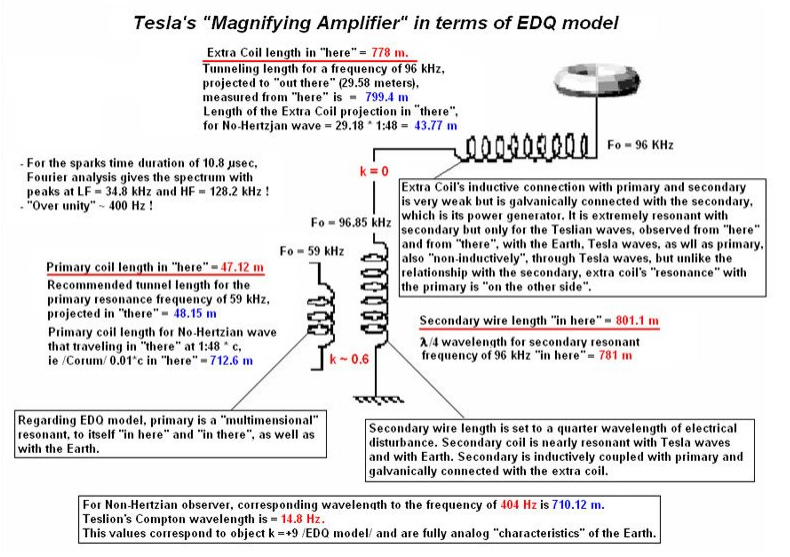
Taking all of these facts into consideration, as well as the characteristics of Tesla’s waves (object k = +9 in the EDQ model), let us try to analyze the electro-mechanical structure of Tesla’s transformer and point out their harmonized interaction—their “resonant” relationship. In this way, our assumption presented in /1/ (that Tesla’s waves are the ONES that carry “free” energy) is not just amplified; it also points to the possibility and very high probability that Tesla’s Magnifying Amplifier could be some kind of “free” energy converter!
All analyses of the operation of Tesla’s transformer done so far have been made by various authors based on a classical scientific approach, covering the calculations of a series of parameters—for instance: spiral inductance, self-capacitance, the mutual inductance coefficient, and so on. In a technical-mathematical sense, they are completely correct. Unfortunately, as a necessary consequence of this perspective, some conclusions are not in accordance with the ideas and experimental results Nikola Tesla actually attained. Certain limitations, classically explained by the theory of relativity (for instance, the speed of light postulate), prevent a “multidimensional” understanding of the “geometry” of Tesla’s device and, consequently, its higher-dimensional interaction “structures.” In our opinion, this is the decisive factor behind the misinterpretations and lack of understanding of real energetic transformations globally, especially in states of “spacetime” deformation (extremely strong fields, short-timed impulses, etc.). Because of this classical framework, the operation of Tesla’s transformer remains unclear, wireless energy conveyance is deemed inefficient (or impossible), and many of Tesla’s other ideas are simply dismissed as absurdity. The EDQ model, however, shows us entirely opposite possibilities.
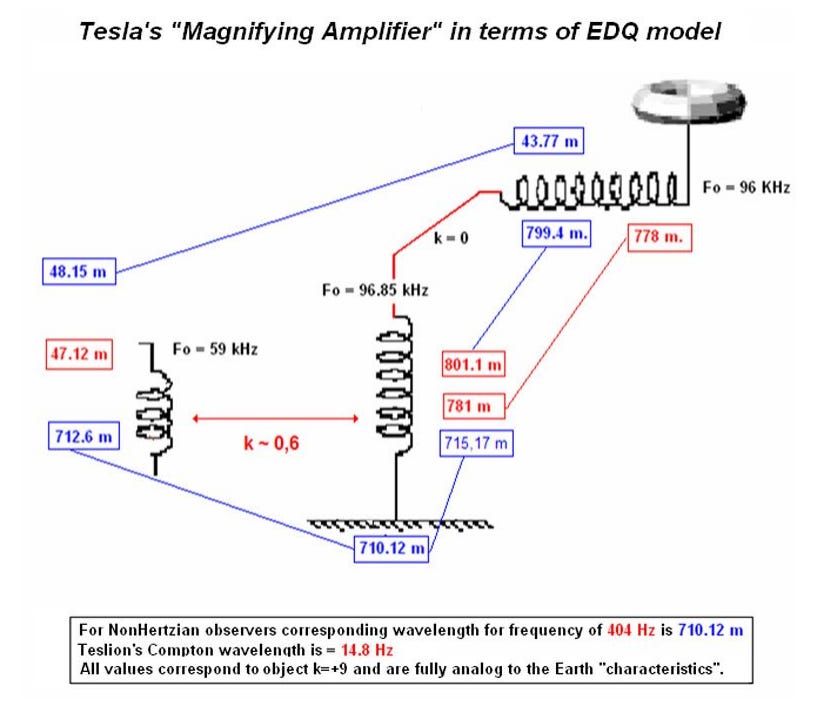
According to our understanding, gained through experience from a great number of thoroughly analyzed experiments, Tesla tried to make his devices for wireless energy conveyance satisfy some sort of “mechanical” resonance in addition to the “ordinary” electrical resonance (inductance and capacitance relationships). Because of this, he paid a great deal of attention to the “geometry” and structural integrity of the construction. There are many detailed analyses regarding the influence of various changes to the spiral coil radii, wire thickness, spacing between certain coils, spiral heights, their positions, and their shapes.

What kind of debates existed among medical scientists and researchers regarding the history of vaccines over the last three centuries? This massive 432-page document, “The History of Vaccination,” contains historical statistics, physicians’ comments, and old records from the 19th century to modern times.
For paid subscribers of Revealed Eye, this complete PDF is now absolutely free!
How to get it?
As soon as you subscribe to the paid version, you will receive an email containing a direct Google Drive link to the PDF.