


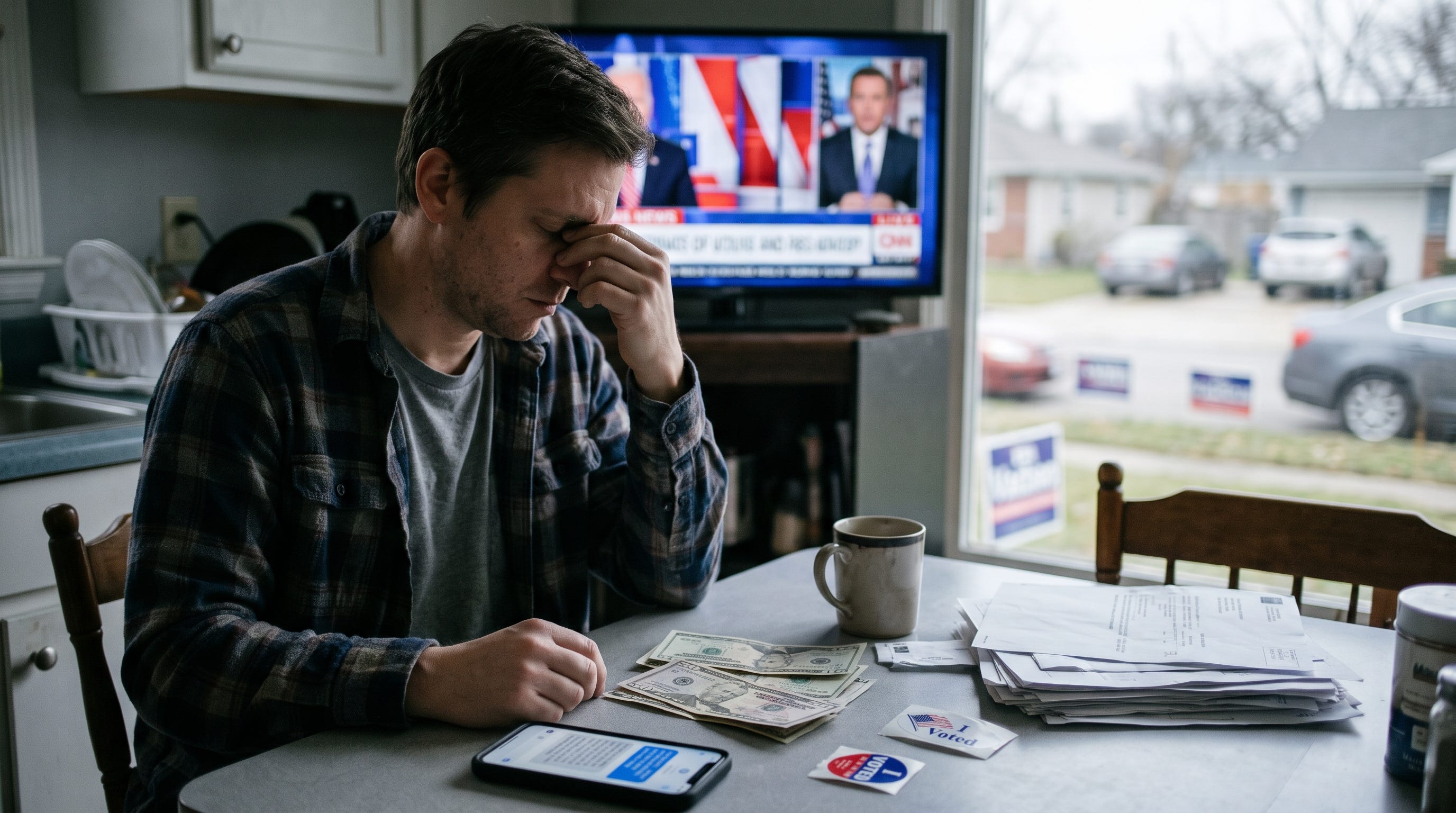
Every couple of years the same ritual plays out. The ads get louder, your phone fills with texts begging for five dollars, and everyone from your cousin to a cable anchor tells you this is the most important election of your lifetime. Then it ends. Somebody wins, somebody cries on TV, and a few months later you’re still staring at the same rent, the same medical bill, the same traffic, the same feeling that nobody in Washington is actually working for you.
If that sounds familiar, you’re not crazy, and you’re not lazy or uninformed. This piece makes the case that a lot of ordinary Americans have quietly reached: that casting a ballot, on its own, changes far less than we’re told it does. It’s the argument skeptics make, and it deserves to be laid out properly, with the details most people skip.
The study everyone argues about
In 2014, political scientists Martin Gilens (Princeton) and Benjamin Page (Northwestern) published a paper that got passed around like a leaked secret. They looked at roughly 1,800 policy questions between 1981 and 2002 and compared what different groups wanted with what the government actually did. Their finding, in plain terms: once you account for what wealthy people and business-backed organizations want, the preferences of the average American had little to no independent effect on outcomes. Ordinary people often got what they wanted, the authors noted, but mostly when it happened to line up with what the affluent also wanted.
Read that again, because it’s the heart of the frustration. It doesn’t say the government never does popular things. It says popularity alone doesn’t seem to be what moves the needle.
And that data stops in 2002. It’s from before Citizens United, before super PACs became a normal part of life, before the 2008 bailouts. People who make this argument say if anything, the gap has likely grown since.
I’m running a special for $40/year or $5/month.
Who actually shows up
There’s an uncomfortable detail hiding in turnout numbers too. A Northwestern analysis of the 2012 election found that 59 percent of voters made $50,000 or more a year, compared with 39 percent of nonvoters. The electorate isn’t a mirror of the country. It leans more comfortable, more settled, more able to take time off, stand in a line, and keep up with the news. So even the “voice of the people” is already filtered before a single vote is counted.
Then there’s the stuff that happens before you ever see a ballot. Most primaries are decided by a small slice of voters. Many districts are drawn so that the general election is basically a formality, and the real contest is who the party picks. If you live in one of those districts, your November vote is a signature on a decision that was made months earlier by people you never met.
Two choices, and a lot of agreement
The other thing nobody says out loud is how narrow the menu is. On a surprising number of the things that shape your daily life, both major parties end up in the same place: the cost of healthcare that keeps climbing, the college debt that doesn’t go away, the housing market that treats first-time buyers like an endangered species, the endless wars that outlast whoever promised to end them. Administrations change and the headlines change, but the grinding structural stuff tends to move glacially, if it moves at all.
A well-known study by economists David Lee, Enrico Moretti and Matthew Butler looked at very close House elections, which work almost like natural experiments. Their conclusion was that voters mostly elect policies rather than affect them. Meaning the winner just votes their own position, and the pressure of a tight race doesn’t push them toward the middle or toward you. You get whichever package wins, not a representative who bends toward what you need.
The History of the ‘House of Rothschild’

The Rothschilds have been in control of the world for a very long time, their tentacles reaching into many aspects of our daily lives, as is documented in the following timeline.
The Decline of Western Society: 10 Signs of Moral Decay and Cultural Collapse

"When a society loses its moral compass, it collapses from within." – G.K. Chesterton.
The real-life version
Here’s how this lands for regular people, away from the theory:
You vote, and then lobbyists decide the details. A bill can pass with a great name and a hollowed-out interior, written with input from the industries it was supposed to regulate. Voters never see that part.
Promises are free. Campaign pledges aren’t contracts. There’s no refund when a candidate ignores one.
Money gets a second vote. Donors, trade groups and PACs speak to the same politicians every week, not every two years.
Local pain doesn’t move national agendas. A closed factory, a hospital that shut its maternity ward, a town with no bus line: these rarely turn into legislation unless somebody with resources pushes it.
None of this feels dramatic day to day. It feels like a slow leak. You do the responsible thing, you vote, and the water bill, the insurance premium and the sense of powerlessness all keep rising anyway.
So what does that mean for you?
The honest takeaway from this side of the argument isn’t “scream into the void.” It’s that the ballot, alone, is a weak tool, and people who treat it as their only tool get the least in return. The groups that do win things tend to do it between elections: unions, tenant associations, parent groups, organized neighbors, local campaigns that show up at council meetings every single month. That’s where individual people have outsized power, because far fewer people are in the room.
So the cynical reading and the practical reading end up in the same place. If you wait for November to fix your life, you’ll be disappointed. If you treat voting as the smallest piece of your involvement rather than the whole of it, you’ll at least be playing the game where it’s actually decided.
Revealed Eye is my full-time, independent work. This platform allows me to stay free from corporate influence, sponsors, and filters and to focus entirely on researching and writing.
If you’d like to support this work and help keep Revealed Eye, consider becoming a paid subscriber. Your support makes it possible for me to keep digging deeper, sharing in-depth investigations, and publishing exclusive content.
I’m running a special for $40/year or $5/month.
To see how readers have benefited from this publication and the community it has built, you can view their feedback here.
Is there a link to where this paper can be found?
This i already knew!